





Table of Contents
- Introduction
- Project Overview
- Route Alignment and Key Intersections
- Construction Phases and Progress
- Economic and Social Impact
- Environmental and Safety Considerations
- Future Prospects and Expansion Plans
- Impact on Real Estate and Industrial Development
- Challenges and Roadblocks
- Expected Toll Rates and Pricing Structure
- Key Takeaways
- Conclusion
- Faq's
Introduction
The Bengaluru-Chennai Expressway (BCE), designated as National Expressway 7 (NE-7), is a transformative infrastructure project aimed at enhancing connectivity between two of South India's major metropolitan cities: Bengaluru, the capital of Karnataka, and Chennai, the capital of Tamil Nadu. This expressway is designed as a high-speed, access-controlled corridor to improve travel efficiency, reduce congestion on existing highways, and support economic growth in the region.
Spanning approximately 258 kilometers, the four-lane (expandable to eight lanes) expressway will significantly cut travel time between Bengaluru and Chennai from over six hours to just three hours. The project passes through three states- Karnataka, Andhra Pradesh, and Tamil Nadu, and is expected to bolster economic activities by facilitating faster transportation of goods and passengers. The expressway is currently under construction and is expected to be fully operational by August 2025.
Project Overview
The BCE is a greenfield expressway project, meaning it is being constructed on a new alignment without utilizing existing roadways. This approach allows for the incorporation of modern design principles and the latest construction technologies, ensuring a high-speed, efficient, and safe transportation corridor. The expressway is designed to support a maximum speed limit of 120 km/h, facilitating swift movement of goods and passengers between the two cities.
Key Specifications
- Total Length: 258 kilometers
- Lanes: Four lanes, expandable to eight
- Design Speed: 120 km/h
- States Covered: Karnataka (71 km), Andhra Pradesh (85 km), Tamil Nadu (106 km)
- Project Cost: Approximately ₹17,930 crores
- Expected Completion: August 2025
Also Read: Mumbai to Goa at Full Speed: Highway Upgrade Set to Change Road Travel
Route Alignment and Key Intersections
The Bengaluru-Chennai Expressway (BCE) begins at Hoskote in the Bangalore Metropolitan Region Development Authority (BMRDA) and stretches 258 km to terminate at Sriperumbudur, located in the Chennai Metropolitan Area. Designed as a high-speed corridor, this expressway traverses multiple key towns and industrial regions, significantly enhancing connectivity and fostering regional economic development across Karnataka, Andhra Pradesh, and Tamil Nadu.
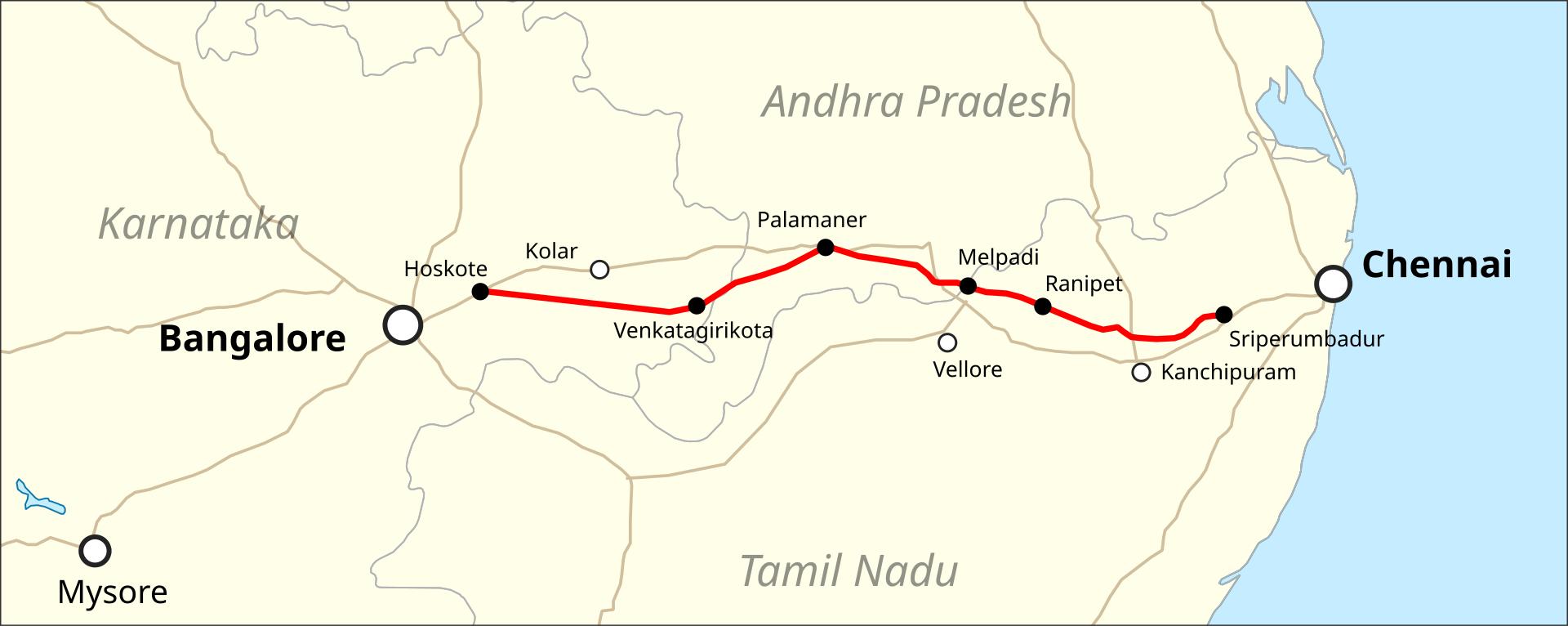 Bengaluru-Chennai Expressway Route Map, Wiki
Major Points Along the Route
- Hoskote, Karnataka (Starting Point)
- Located just 25 km from Bengaluru, Hoskote serves as the starting point of the expressway.
- The region is rapidly emerging as a major industrial and logistics hub, with large warehouses and manufacturing units being set up along NH 75.
- Hoskote is strategically positioned at the intersection of multiple highways, making it a key transit point for goods moving in and out of Bengaluru.
- Malur, Karnataka (An Emerging Industrial Town)
- Malur, situated in Kolar district, is known for its industrial clusters, primarily in the automobile and textile industries.
- The expressway is expected to boost real estate growth, with new residential and commercial projects catering to industrial workers and businesses.
- The town has seen increased investments in logistics and warehousing, positioning itself as an extension of Bengaluru's industrial landscape.
- Bangarpet, Karnataka (Proximity to Kolar Gold Fields)
- Bangarpet, historically known for its proximity to the Kolar Gold Fields (KGF), has evolved into a key commercial and agricultural center.
- The town is a major transportation hub, connecting Karnataka to Tamil Nadu and Andhra Pradesh.
- The expressway is expected to reduce transit times for goods and agricultural products, benefiting local industries and businesses.
- Bethamangala, Karnataka (Town Near the Andhra Pradesh Border)
- Bethamangala is a smaller town but plays a significant role due to its proximity to Andhra Pradesh.
- Known for its reservoir and water supply projects, Bethamangala is strategically important for local agriculture.
- Improved connectivity through the expressway will promote cross-border trade between Karnataka and Andhra Pradesh.
- Palamaner, Andhra Pradesh (A Key Junction in Chittoor District)
- Palamaner is an important town in Chittoor district, known for its agriculture, poultry, and dairy industries.
- It serves as a transit point for vehicles moving towards Tirupati, Chennai, and Bengaluru.
- The expressway will significantly boost the economy of the town by improving trade logistics and attracting new businesses.
- Chittoor, Andhra Pradesh (A Significant Commercial Center)
- Chittoor is a major agricultural and commercial hub, famous for its dairy farming and mango production.
- The expressway will connect Chittoor more efficiently to industrial centers in Tamil Nadu and Karnataka, benefiting food processing, logistics, and export industries.
- The city is also expected to see a rise in real estate demand, with better accessibility attracting industries and residential developments.
- Ranipet, Tamil Nadu (An Industrial Hub)
- Ranipet is one of Tamil Nadu's biggest industrial zones, home to leather manufacturing, chemical plants, and engineering industries.
- With better expressway connectivity, industries here will be able to move goods more efficiently, reducing logistics costs and increasing exports.
- The expressway will also help decongest existing road networks, particularly NH 48, which currently handles heavy industrial traffic.
- Sriperumbudur, Tamil Nadu (The Expressway Endpoint and an Automotive Hub)
- Sriperumbudur is the final destination of the expressway, known for being an automotive and electronics manufacturing hub.
- The region houses several major industries, including plants for companies like Hyundai, Nissan, Daimler, and Foxconn.
- Improved connectivity will boost industrial expansion, attract foreign investments, and further strengthen Sriperumbudur's role as a manufacturing powerhouse.
Also Read: Regional Ring Road Hyderabad: Route, Connectivity, and Real Estate Impact
Construction Phases and Progress
The construction of the BCE is divided into multiple phases and packages to streamline execution and ensure timely completion. As of December 2024, the 71-kilometer stretch within Karnataka has been completed and opened to traffic. The remaining sections in Andhra Pradesh and Tamil Nadu are under various stages of construction, with full completion targeted for August 2025.
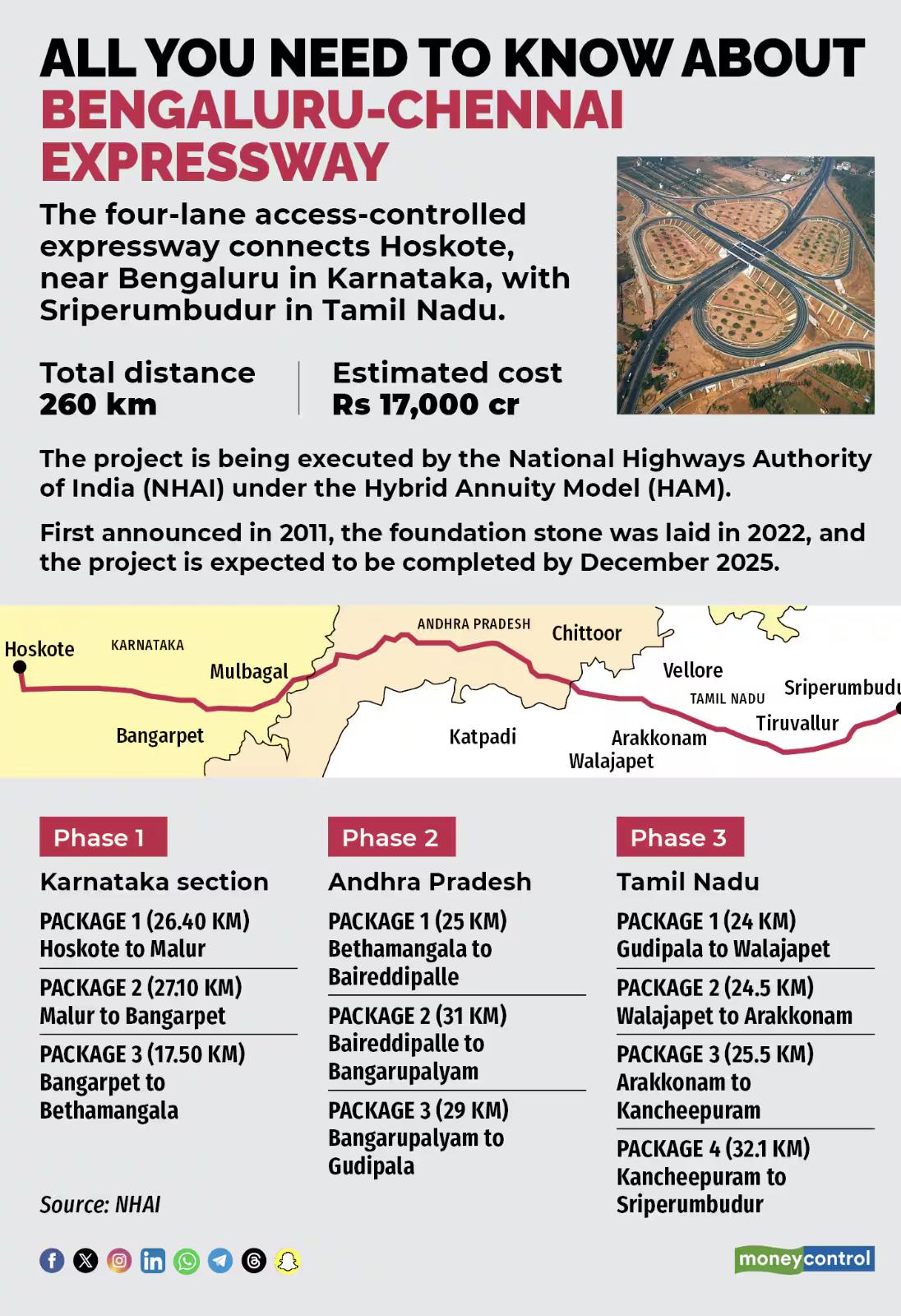 Bengaluru Chennai Expressway Details, MoneyControl
Phase-wise Breakdown
- Phase I: Karnataka Section
- Length: 71 kilometers
- Status: Completed and operational since December 2024
- Key Contractors: Dilip Buildcon, KCC Buildcon
- Phase II: Andhra Pradesh Section
- Length: 85 kilometers
- Status: Under construction
- Key Contractors: Montecarlo Limited, APCO Infratech, Dilip Buildcon
- Phase III: Tamil Nadu Section
- Length: 106 kilometers
- Status: Under construction
- Key Contractors: Montecarlo Limited, KCC Buildcon, DP Jain Infra, RCC Constructions
The project has faced challenges such as land acquisition hurdles and contractor delays, leading to adjustments in timelines. However, concerted efforts by the National Highways Authority of India (NHAI) and state governments have facilitated progress, keeping the project on track for its revised completion date.
Economic and Social Impact
The BCE is anticipated to be a catalyst for economic growth in the region. By reducing travel time between Bengaluru and Chennai from over six hours to approximately three hours, the expressway will facilitate faster movement of goods and people, thereby enhancing trade and commerce.
Key Benefits
- Enhanced Connectivity: Improved access between major industrial hubs
- Economic Development: Stimulation of industrial and commercial activities along the corridor
- Real Estate Growth: Increased demand for residential and commercial properties in proximate areas
- Employment Opportunities: Creation of jobs during construction and in ancillary industries post-completion
The expressway is also expected to promote the Chennai-Bangalore Industrial Corridor (CBIC), envisaged as a key manufacturing and industrial hub, further bolstering the region's economic landscape.
Also Read: Mumbai Nagpur Expressway - Features, Highlights, Tourist Destinations
Environmental and Safety Considerations
As a greenfield project, the BCE has been designed with environmental sustainability in mind. Measures have been implemented to minimize ecological disruption, including the construction of animal underpasses and careful alignment planning to avoid sensitive areas.
Safety features are integral to the expressway's design, with provisions for vehicular underpasses, pedestrian crossings, and state-of-the-art traffic management systems to ensure the safety of commuters.
Future Prospects and Expansion Plans
The Bengaluru-Chennai Expressway (BCE) is not just an infrastructure milestone but a foundation for future expansion and connectivity enhancements. Several strategic initiatives and complementary projects are expected to further bolster its effectiveness.
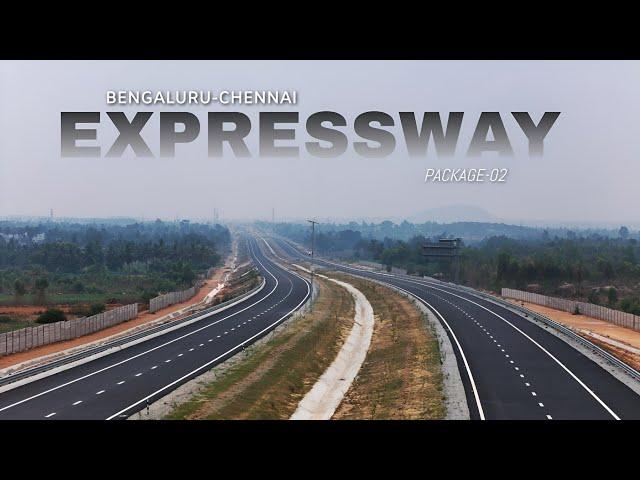 Bengaluru Chennai Expressway Future Prospects, Youtube
Proposed Expansions and Connectivity Enhancements
- Expressway Extension to Chennai Port
- The expressway may see an extension towards Chennai Port, enhancing logistics and trade efficiency.
- A dedicated freight corridor is being considered to facilitate the movement of goods to and from the port.
- Integration with Other Expressways
- The BCE is expected to integrate seamlessly with upcoming expressway networks, such as the Mumbai-Bengaluru Expressway and the Chennai-Salem Expressway, ensuring better intercity connectivity.
- Smart Expressway Features
- Plans are in place to integrate AI-powered traffic monitoring, automatic toll collection, and emergency response systems.
- The inclusion of electric vehicle (EV) charging stations along the route aligns with India's push towards sustainable mobility.
- Potential Upgradation to Eight Lanes
- With increasing traffic projections, feasibility studies are being conducted for an expansion to an eight-lane expressway in the future.
Also Read: Bangalore-Mysore Expressway: Updates, Key Facts, Latest Toll Rates
Impact on Real Estate and Industrial Development
The Bengaluru-Chennai Expressway (BCE) is set to redefine the real estate and industrial landscape along its corridor, unlocking new growth opportunities for residential, commercial, and industrial development. With the reduced travel time between Bengaluru and Chennai, the expressway is expected to increase demand for housing, commercial spaces, and logistics infrastructure.
Real Estate Boom Along the BCE Corridor
The expressway is expected to be a game changer for real estate growth, especially in satellite towns and peri-urban areas that were previously less accessible. Investors, developers, and businesses have already started acquiring land in anticipation of high appreciation rates post-completion. The following regions are expected to experience rapid real estate expansion:
1. Hoskote and Malur (Karnataka)- Logistics & Residential Growth
- Hoskote, a prominent suburb near Bengaluru, is witnessing a surge in plotted developments, residential projects, and commercial real estate.
- With improved connectivity, logistics hubs and warehousing facilities are expanding, catering to e-commerce, manufacturing, and retail businesses.
- Malur, a growing industrial town, is seeing an influx of affordable and mid-segment housing projects catering to industrial workers and professionals.
- The area is expected to become a major transit hub, attracting large-scale investments from logistics companies and industrial players.
2. Palamaner and Chittoor (Andhra Pradesh)- Affordable Housing & Commercial Growth
- The expressway will unlock new real estate potential in Andhra Pradesh, with Palamaner and Chittoor emerging as key commercial and residential hubs.
- Palamaner, known for its agriculture, poultry, and small-scale industries, is expected to see the development of affordable housing projects for working professionals.
- Chittoor, already a commercial center, will benefit from new real estate developments, including mid-rise residential complexes, shopping centers, and office spaces.
- Land values along the expressway corridor are expected to rise, encouraging developers to invest in mixed-use projects and gated communities.
3. Ranipet and Sriperumbudur (Tamil Nadu)- Industrial & Residential Expansion
- Ranipet is a well-established industrial town with strong manufacturing and chemical industries. With the expressway reducing transit times, demand for industrial land is soaring.
- The town is expected to see significant warehousing expansion, catering to manufacturing and logistics firms looking for faster transportation access.
- Sriperumbudur, already a global manufacturing hub for automobile and electronics giants, will witness massive real estate growth in industrial, commercial, and residential segments.
- The presence of major multinational companies such as Hyundai, Foxconn, Nissan, and Daimler will attract more businesses, boosting real estate demand for employee housing and commercial developments.
 Real Estate and Industrial Growth
Industrial Growth and Economic Corridors
The expressway will directly complement the Chennai-Bangalore Industrial Corridor (CBIC), one of India's most ambitious infrastructure and economic development projects. The CBIC, with its integrated industrial clusters, aims to:
1. Promote Automobile, Electronics, and Manufacturing Industries
- The automobile industry in Sriperumbudur and Chennai will benefit from faster supply chain movement and reduced logistics costs.
- Electronics manufacturing hubs in Chennai and Bengaluru will experience greater efficiency, with companies like Foxconn, Wistron, and Dell leveraging the expressway for seamless connectivity.
- The pharmaceutical and FMCG sectors will also witness enhanced trade efficiency, as goods can be transported quickly between production units and distribution centers.
2. Facilitate Growth of Logistics and Warehousing Hubs
- The expressway will drive the expansion of logistics hubs in Ranipet, Sriperumbudur, and Chittoor, making them ideal locations for warehousing, e-commerce fulfillment centers, and transportation depots.
- With better road connectivity, companies can relocate their warehousing operations from congested city centers to these new hubs, optimizing costs and efficiency.
- E-commerce giants like Amazon, Flipkart, and Reliance Retail are likely to establish large distribution centers along the expressway, further boosting job creation.
3. Attract Foreign Direct Investment (FDI) in Industrial Zones
- The improved connectivity and faster transit times will make the region more attractive to global investors.
- FDI in manufacturing is expected to increase, with companies in the automobile, textile, and engineering sectors setting up operations along the expressway.
- The government's push for "Make in India" initiatives and infrastructure development will further drive foreign and domestic investments into special economic zones (SEZs) and industrial parks.
Challenges and Roadblocks
Despite its promise, the BCE project has faced some hurdles, including:
- Land Acquisition Issues
- Resistance from local landowners delayed portions of the project.
- Compensation negotiations and legal interventions were required in some areas.
- Environmental Concerns
- Concerns over the impact on agricultural land and forest areas required ecological impact assessments and mitigation strategies.
- Wildlife conservationists advocated for animal overpasses in key regions.
- Contractual and Construction Delays
- Some packages faced slow execution due to financial constraints and contractor inefficiencies.
- NHAI reallocated contracts to new firms in cases of non-performance.
- Toll and Pricing Issues
- Discussions are ongoing regarding toll pricing structures to balance affordability with infrastructure maintenance.
Expected Toll Rates and Pricing Structure
While exact toll rates are yet to be finalized, industry estimates suggest:
- Light Vehicles (Cars, SUVs, Motorcycles): ₹1.50- ₹2.00 per km.
- Heavy Vehicles (Trucks, Buses): ₹4.00- ₹5.00 per km.
Frequent commuters and commercial transporters can expect electronic toll collection (FASTag) discounts.
Key Takeaways
- The 258-km expressway will cut travel time to just 3 hours.
- The project is expected to boost industrial and real estate development.
- Environmental and safety measures have been incorporated.
- Future expansions include EV charging infrastructure and potential lane upgradation.
- Despite challenges, the BCE is on track for full operation by August 2025.
As the project nears completion, all eyes are on the expressway to deliver seamless, high-speed connectivity and transform the economic landscape of Karnataka, Andhra Pradesh, and Tamil Nadu.
Conclusion
The Bengaluru-Chennai Expressway (BCE) is poised to be a transformative project for South India, drastically improving intercity travel, boosting industrial growth, and enhancing logistics efficiency. With an estimated completion date of August 2025, this expressway will play a pivotal role in reducing travel time, increasing regional trade, and driving economic prosperity.

explore further
Latest from Location Reviews
More from Recommendations
Resources


