




Table of Contents
- Introduction
- Project Overview
- Route and Connectivity
- Land Acquisition and Development Phases
- Government Initiatives and Future Plans
- Impact on Real Estate Market
- Conclusion
- Faq's
The Hyderabad Regional Ring Road (RRR) is poised to be a transformative infrastructure project, significantly enhancing connectivity and fostering economic growth in Telangana. As one of India's most ambitious ring road initiatives, the RRR is set to redefine transportation and real estate dynamics in and around Hyderabad.
Introduction
The Regional Ring Road (RRR) is a visionary infrastructure project designed to enhance Hyderabad's transportation network and support its growing urban sprawl. As the city expands beyond the Outer Ring Road (ORR), there is an increasing need for efficient connectivity to peripheral towns, industrial hubs, and satellite cities. The RRR will act as a strategic corridor, easing congestion in the city's core while facilitating smoother transit for commercial and passenger vehicles. By linking multiple national and state highways, the expressway will significantly reduce travel time and improve logistical efficiency, fostering economic growth across Telangana.
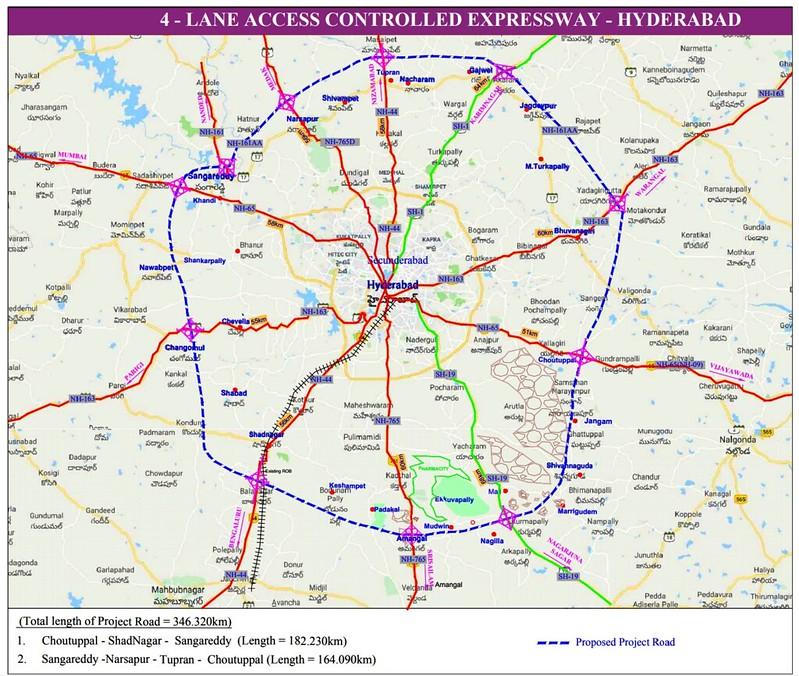 RRR Hyderabad, Metro Rail Guy
Beyond easing traffic congestion, the RRR is expected to spur real estate development, industrial expansion, and investment opportunities along its corridor. The project will play a pivotal role in decentralizing Hyderabad's urban landscape, encouraging planned suburban growth and reducing the burden on the city's central districts. With improved access to business districts, tech parks, and logistics hubs, the RRR is set to create new employment corridors and drive infrastructure-led economic progress. The initiative aligns with Telangana's long-term vision of positioning Hyderabad as a smart and well-connected global city, ensuring sustainable urban growth while maintaining ease of mobility.
Also Read: Impact of Mumbai Coastal Road: A Game-Changer for Real Estate
Project Overview
The RRR is being developed under Phase 1 of the Bharatmala Pariyojana project, with an estimated budget of ₹17,000 crore. The National Highways Authority of India (NHAI) is overseeing its construction. The expressway is designed to be semi-greenfield, combining new construction with upgrades to existing roadways, and will be implemented in two primary sections:
- Northern Section: Spanning approximately 164 kilometers, this segment will connect key areas such as Sangareddy, Narsapur, Toopran, Gajwel, Yadadri, Pragnapur, Bhongir, and Choutuppal.
- Southern Section: Covering around 182 kilometers, this portion will link Choutuppal, Ibrahimpatnam, Kandukur, Amangal, Chevella, Shankarpally, and Sangareddy.
The RRR will intersect with 17 national and state highways, including NH 65, NH 44, NH 163, and NH 765, thereby enhancing regional connectivity.
Route and Connectivity
The RRR is strategically planned to improve access between various districts and towns surrounding Hyderabad. Positioned approximately 30 to 50 kilometers from the existing ORR, it will serve as a vital link for numerous localities. The expressway will feature eight interchanges in its northern section, facilitating seamless transitions to major highways. Notable interchanges include:
- Hyderabad-Mumbai National Highway Interchange: Located between Peddapur and Girmapur villages.
- Sangareddy-Nanded Road Interchange: Near Fasalwadi, close to Shivampet.
- Hyderabad-Medak Road Interchange: Situated between Reddypalli and Chinthakunta.
- Hyderabad-Nagpur Highway Interchange: Near Masaipet, close to Toopran.
- Hyderabad-Karimnagar (Rajiv Highway) Interchange: At Gundanpally, near Gouraram.
- Hyderabad-Warangal National Highway Interchange: Located in Bhuvanagiri.
- Jagdevpur-Choutuppal (Bhuvanagiri-Nalgonda) Road Interchange: Between Mandapuram and Penumativanigudem.
- Hyderabad-Vijayawada Highway Interchange: Near Bangarigadda, close to Choutuppal.
These interchanges are designed to ensure efficient traffic flow and connectivity across the region.
Also Read: Goregaon-Mulund Link Road: A Catalyst For Connectivity & Real Estate Transformation
Land Acquisition and Development Phases
 Development Phases
- The land acquisition process for the Regional Ring Road (RRR) is a critical component of the project's execution, ensuring a smooth transition from planning to construction. Given the massive scale of the project, the process involves coordination between the central and state governments, with both sharing 50% of the acquisition costs. To facilitate this, the Telangana state government has earmarked ₹1,525 crore, ensuring adequate funding to compensate landowners and expedite clearances. This financial commitment underscores the government's determination to fast-track the RRR project and meet its infrastructure expansion goals. The process involves identifying affected landowners, determining compensation packages, and negotiating settlements to acquire land in a legally compliant and socially responsible manner.
- As of the latest updates, land acquisition for the northern section of the RRR is nearing completion, signaling that construction could commence soon. This section is crucial as it connects Sangareddy, Narsapur, Toopran, Gajwel, Yadadri, Pragnapur, Bhongir, and Choutuppal, all of which are emerging economic hubs. With most of the required land secured, the National Highways Authority of India (NHAI) has invited bids for the construction of the four-lane access-controlled highway, setting the submission deadline for February 14, 2025. This milestone indicates that the project is progressing towards the execution phase, ensuring that key connectivity corridors in Telangana are strengthened.
- Meanwhile, efforts for land acquisition in the southern section have officially commenced, marking another step toward the full-scale implementation of the RRR. This section, spanning Choutuppal, Ibrahimpatnam, Kandukur, Amangal, Chevella, Shankarpally, and Sangareddy, is vital for linking Hyderabad to southern Telangana's industrial and agricultural belts. The state government is working closely with local authorities and stakeholders to expedite the process while ensuring that compensation and rehabilitation plans are executed fairly. Once land acquisition in this segment reaches an advanced stage, construction bids for the southern section will also be invited, paving the way for the project's full-scale execution and completion in the coming years.
Government Initiatives and Future Plans
 Future plans and initiatives
- To further enhance urban mobility, reduce congestion, and promote sustainable transport solutions, the Telangana government has proposed the development of a Regional Ring Railway (RRR Railway) alongside the Regional Ring Road (RRR). This initiative is part of a larger vision to create a multi-modal transport network, ensuring seamless connectivity between Hyderabad's core city, its surrounding districts, and neighboring states. By establishing two concentric circles of high-speed roadways and railway lines, interconnected by radial roads, the government aims to provide efficient transit solutions for both passengers and freight movement. The railway component will complement the road infrastructure, reducing over-reliance on road transport and supporting eco-friendly urban expansion.
- The Regional Ring Railway will connect major industrial zones, satellite townships, and logistics hubs, allowing for faster movement of goods and people. With Hyderabad's rapid growth as a tech and business hub, this initiative will help decentralize development, ensuring that economic opportunities are spread beyond the city's core. The government envisions that integrating road and rail networks will enable seamless last-mile connectivity, making Hyderabad a model city for sustainable infrastructure development. This ambitious plan aligns with the National Infrastructure Pipeline (NIP) and Bharatmala Pariyojana, supporting the broader goal of developing India's transport sector to global standards.
- Beyond connectivity, the Telangana government is focused on making Hyderabad one of the fastest and greenest cities in the world. With increasing concerns over urban pollution, congestion, and travel time delays, projects like the RRR and Regional Ring Railway will contribute to reducing carbon emissions, encouraging the use of public transport, and promoting transit-oriented development. Future plans also include smart traffic management systems, electric vehicle corridors, and energy-efficient infrastructure to support Hyderabad's vision of becoming a global smart city. These initiatives will not only improve Hyderabad's urban mobility but also position it as a leader in sustainable and well-planned urbanization in India.
Also Read: Agra-Lucknow Expressway : Route Details, Toll Rates, Amenities
Impact on Real Estate Market
The Regional Ring Road (RRR) is poised to transform Hyderabad's real estate landscape, unlocking new opportunities for residential, commercial, and industrial developments. With enhanced connectivity, peripheral regions that were once considered remote are now expected to become prime investment destinations. The RRR will serve as a catalyst for urban expansion, attracting businesses, industries, and real estate developers to capitalize on the improved accessibility and infrastructure. Below is an in-depth analysis of how the RRR will impact different real estate segments:
 Impact on Real Estate
1. Industrial Clusters and Logistics Parks
The RRR corridor is expected to emerge as a major industrial and logistics hub, given its proximity to highways and reduced travel time for goods transport. The improved transportation infrastructure will encourage warehousing, manufacturing units, and logistics companies to establish operations along the expressway. Industrial belts such as Sangareddy, Toopran, and Choutuppal are likely to see increased investments in SEZs (Special Economic Zones), logistics parks, and export hubs. The ease of goods movement between Telangana, Maharashtra, Andhra Pradesh, and Karnataka will further boost trade and supply chain efficiency, making this region attractive for businesses seeking cost-effective and strategically located industrial spaces.
2. IT Centers and Business Hubs
As Hyderabad continues to be a leading IT and startup hub, the RRR will support the expansion of IT clusters beyond the traditional tech corridors like Hitec City and Gachibowli. Areas along the RRR, such as Shankarpally, Chevella, and Amangal, offer ample land for new IT parks, business hubs, and coworking spaces. The availability of affordable commercial spaces, combined with enhanced connectivity, will attract technology firms, fintech startups, and multinational corporations looking to expand their operations. With Hyderabad's IT industry growing rapidly, these peripheral regions could become the next wave of IT development zones, much like how the ORR facilitated the rise of Gachibowli and Madhapur.
3. Satellite Townships and Affordable Housing
The RRR will drive the development of planned satellite townships, addressing the rising demand for affordable and mid-range housing options. With property prices skyrocketing in central Hyderabad, areas like Ibrahimpatnam, Kandukur, and Bhongir are gaining traction as emerging residential destinations. Developers are expected to launch integrated townships, gated communities, and plotted developments, catering to middle-income and first-time homebuyers. The presence of quality infrastructure, schools, hospitals, and shopping centers will further make these locations desirable for families looking for a better quality of life at competitive prices.
4. Commercial Developments and Retail Expansion
As connectivity improves, commercial establishments such as malls, retail chains, hotels, and entertainment centers will spring up along the RRR corridor. Key junctions and interchanges are likely to witness the rise of shopping complexes, multiplexes, office spaces, and business centers, catering to the growing population in emerging suburban hubs. Areas like Yadadri, Choutuppal, and Sangareddy are well-positioned to become commercial hotspots, offering a mix of office spaces, showrooms, and hospitality projects. This expansion will also support job creation and economic growth, further reinforcing the demand for both commercial and residential real estate.
5. Significant Appreciation in Land and Property Prices
Historical data indicates that infrastructure projects like the Outer Ring Road (ORR) led to exponential increases in property values. The RRR is expected to follow a similar trajectory, with land prices along the corridor witnessing substantial appreciation over time. As demand rises for commercial, industrial, and residential projects, investors and developers are already eyeing key locations along the RRR for future projects. Areas that are currently underdeveloped or agricultural land will soon transform into urban hubs, driving high ROI (Return on Investment) for early buyers and investors. With real estate demand shifting towards well-connected peripheral locations, the RRR will play a key role in shaping Hyderabad's future urban landscape.
Conclusion
The Hyderabad Regional Ring Road is set to be a game-changer for the city's infrastructure and real estate sectors, unlocking new opportunities for economic growth and urban expansion. By enhancing regional connectivity, reducing congestion, and supporting industrial and residential developments, the RRR will play a pivotal role in Hyderabad's future. With strong government backing and phased execution, the project is expected to be a catalyst for multi-sectoral growth in Telangana.

explore further
Latest from Location Reviews
More from Recommendations
Resources


