





Table of Contents
- Introduction
- Project Overview
- Route Alignment
- Key Features
- Construction Status of the Delhi-Jaipur Super Expressway
- Real Estate Impact of the Delhi-Jaipur Super Expressway
- Integration with Other Projects
- Benefits to Commuters
- Challenges and Mitigation
- Future Prospects
- Conclusion
- Faq's
Introduction
The Delhi-Jaipur Expressway, officially designated as NH-352B, is a transformative infrastructure project aimed at enhancing connectivity between India's capital, New Delhi, and the historic city of Jaipur in Rajasthan. This greenfield expressway is poised to significantly reduce travel time, bolster economic activities, and stimulate real estate development along its corridor.
Project Overview
The Delhi-Jaipur Super Expressway is a crucial infrastructure project aimed at enhancing connectivity between Delhi and Jaipur. Spanning 195.1 kilometers, this six-lane access-controlled highway is designed to facilitate high-speed travel while accommodating future expansion needs. The project is being executed by the National Highways Authority of India (NHAI) under its initiative to modernize India's road network. With a budget of approximately ₹6,530 crore, the expressway is part of the broader strategy to improve regional connectivity and boost economic activities along its corridor.
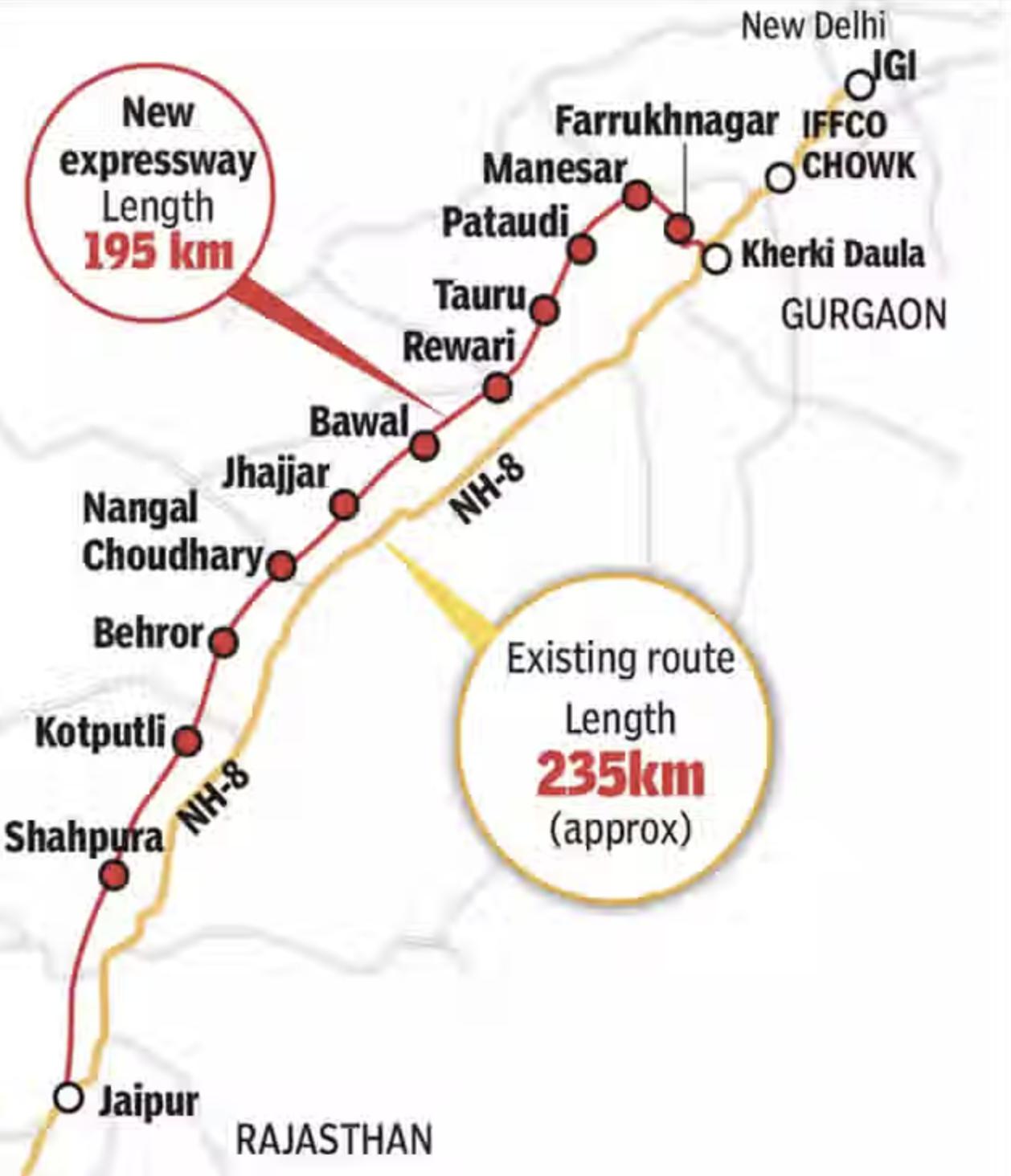 Delhi-Jaipur Super Expressway, Swarajya
One of the major advantages of the Delhi-Jaipur Expressway is the significant reduction in both travel distance and time. By offering a more direct route, it will shorten the existing Delhi-Jaipur distance by around 40 kilometers, eliminating congestion-prone stretches on NH-48. This optimization will result in a travel time reduction of 2 to 3 hours, enabling commuters to cover the journey in approximately two and a half to three hours, compared to the current five to six hours. This will not only enhance passenger convenience but also benefit logistics, trade, and tourism between the two cities.
The expressway is also expected to integrate with major infrastructure projects such as the Delhi-Mumbai Expressway and the Dwarka Expressway, ensuring seamless intercity and interstate connectivity. With its high-speed design, advanced safety features, and modern road engineering, the project aims to set new benchmarks in India's expressway infrastructure. Upon completion, it will reduce fuel consumption, lower vehicular emissions, and provide a smoother, congestion-free commuting experience, significantly benefiting both personal and commercial transportation.
Also Read: Pune Ring Road Project: Route, Cost, Latest Updates, and Real Estate Impact
Route Alignment
The Delhi-Jaipur Super Expressway follows a carefully planned route alignment to ensure maximum connectivity, economic benefits, and minimal environmental disruption. The expressway originates near the Kherki Daula Toll Plaza on NH-48 in Gurgaon, Haryana, a key point for traffic movement between Delhi and other parts of North India. From there, it will extend southwest, bypassing heavily congested areas, and will culminate near Chandwaji in Jaipur, Rajasthan. This strategic alignment not only facilitates smoother traffic flow but also serves as an essential corridor for commercial, industrial, and passenger transit.
The expressway will traverse seven major districts, covering regions in Haryana and Rajasthan. These districts include Gurgaon, Rewari, Jhajjar, Mahendragarh, Alwar, Sikar, and Jaipur, all of which are expected to witness substantial economic and infrastructural growth due to the improved connectivity. The route has been carefully selected to avoid densely populated urban areas while ensuring that key industrial hubs and logistics centers are well-connected. This will help decongest existing highways, particularly NH-48, and provide a more efficient alternative for long-distance and freight transportation.
In addition to boosting interstate travel, the expressway will pass through approximately 423 villages, positively impacting rural development along its corridor. The alignment has been designed to minimize environmental disruption by incorporating sustainable infrastructure solutions, such as sound barriers, eco-friendly drainage systems, and extensive tree plantations along the route. This project also focuses on reducing land acquisition conflicts by engaging with local stakeholders and ensuring fair compensation policies. Upon completion, the Delhi-Jaipur Expressway will serve as a model expressway, demonstrating how modern road infrastructure can balance economic growth with environmental responsibility.
Key Features
High-Speed Connectivity
The Delhi-Jaipur Super Expressway is designed to accommodate high-speed vehicular movement with a maximum speed limit of 120 km/h, significantly reducing travel time between Delhi and Jaipur. By eliminating congestion points and integrating access-controlled entry and exit points, the expressway will provide a seamless, uninterrupted travel experience. With a six-lane expandable design, the project ensures future scalability to meet increasing traffic demands, making it one of the fastest and most efficient road corridors in North India.
Safety Enhancements
Commuter safety is a top priority for the expressway, with modern road engineering techniques incorporated to minimize risks and enhance driving conditions. The project will feature advanced surveillance systems, including CCTV monitoring, speed detection radars, and emergency response services along the entire stretch. Additionally, well-designed interchanges, flyovers, service lanes, and pedestrian-friendly zones will be implemented to ensure smooth traffic flow and reduce accident-prone areas. Dedicated emergency response stations will be strategically located to provide quick assistance in case of breakdowns or accidents.
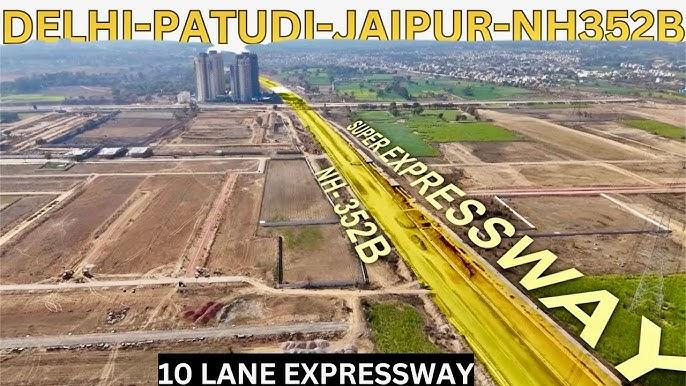 Delhi-Jaipur Expressway, Youtube
Economic Growth
The expressway is expected to catalyze economic development by improving connectivity between Delhi NCR and Rajasthan, two of India's key economic hubs. Enhanced infrastructure will streamline logistics, facilitate trade, and improve supply chain efficiency, particularly benefiting industries, businesses, and tourism. As a result, areas along the expressway, such as Rewari, Neemrana, and Alwar, are projected to witness significant industrialization, increased investment, and a rise in employment opportunities. The hospitality, retail, and commercial sectors are also expected to flourish, making the corridor a key driver of regional economic growth.
Environmental Considerations
Sustainability is a core aspect of the Delhi-Jaipur Expressway, with several eco-friendly measures integrated into its design. The project includes extensive tree plantations along the median and roadside to offset carbon emissions and enhance air quality. Additionally, advanced drainage systems and rainwater harvesting infrastructure will be implemented to prevent waterlogging and conserve water resources. The expressway will also feature dedicated electric vehicle (EV) charging stations and solar-powered lighting, reducing dependence on conventional energy sources and promoting a greener, more sustainable transport ecosystem.
Also Read: Bengaluru-Chennai Expressway (NE-7): Route, Updates, Toll, and Completion Timeline
Construction Status of the Delhi-Jaipur Super Expressway
- As of February 2025, the Delhi-Jaipur Super Expressway is in its land acquisition phase, with several sections already earmarked for construction. The National Highways Authority of India (NHAI), responsible for executing the project, is actively working to acquire land parcels across Haryana and Rajasthan while ensuring minimal disruption to local communities. In many areas, the groundwork, such as site surveys, soil testing, and environmental assessments, has already been completed. Additionally, the government has been offering compensation packages and rehabilitation plans to landowners to facilitate smooth acquisition and prevent delays due to legal disputes. The project follows a phased construction model, allowing work to begin on sections where land acquisition is complete while negotiations continue in other areas.
- With the expressway expected to be fully operational by 2027, NHAI has been prioritizing stakeholder engagement to resolve any challenges that could hinder progress. Collaboration between state governments, local authorities, and private contractors is being strengthened to streamline approvals and accelerate construction activities. Moreover, NHAI has been leveraging advanced engineering techniques and modern construction technologies to ensure the expressway is built efficiently and adheres to international road safety standards. If executed as planned, the Delhi-Jaipur Expressway will become a landmark project in India's highway infrastructure, reducing congestion on NH-48 and significantly improving travel time, freight movement, and regional connectivity.
Real Estate Impact of the Delhi-Jaipur Super Expressway
 Real Estate Impact
- The Delhi-Jaipur Super Expressway is expected to act as a catalyst for real estate growth along its corridor, transforming the regions it passes through into potential investment hotspots. Improved accessibility and reduced travel time between Delhi and Jaipur will make areas along the expressway more attractive for residential, commercial, and industrial development. Cities like Gurgaon, Rewari, Alwar, and Jaipur, which are already experiencing growth, are expected to witness a further surge in real estate demand as connectivity enhances economic opportunities. Townships, logistics hubs, and business parks are likely to emerge in the peripheral areas, capitalizing on the expressway's connectivity.
- Residential real estate will particularly benefit from the increased influx of professionals, business owners, and daily commuters who seek well-connected yet more affordable housing options outside of Delhi and Gurgaon. Integrated townships, plotted developments, and gated communities are likely to see a rise in demand, especially in regions like Rewari, Neemrana, and Alwar, where land is still available at competitive rates. Jaipur, already a preferred destination for tourism and business, will gain further prominence as an ideal city for second-home buyers and investors looking for high appreciation potential.
- On the commercial and industrial front, the expressway will open up new logistics corridors, warehousing zones, and business districts, particularly near industrial belts in Manesar, Bhiwadi, and Neemrana. The ease of freight movement between Delhi, Jaipur, and beyond will make these locations preferred choices for e-commerce companies, manufacturing units, and logistics providers. Additionally, retail developments, hospitality projects, and IT parks are expected to flourish along the expressway, especially in upcoming commercial hubs near major interchanges. As work on the expressway progresses, property values are projected to appreciate significantly, offering lucrative opportunities for both homebuyers and investors. This infrastructure-driven real estate boom is set to redefine urban expansion along the Delhi-Jaipur corridor, making it a key growth zone in North India.
Also Read: Mumbai to Goa at Full Speed: Highway Upgrade Set to Change Road Travel
Integration with Other Projects
The expressway will integrate with existing infrastructure, including the Delhi-Mumbai Expressway and the Dwarka Expressway, enhancing regional connectivity. This integration is expected to streamline traffic flow and provide seamless travel experiences for commuters.
Benefits to Commuters
|
Benefit |
Description |
|
Reduced Travel Time |
The expressway will cut travel time between Delhi and Jaipur by 2 to 3 hours, reducing the journey from the current 5-6 hours to approximately 2.5-3 hours. This will be achieved through an access-controlled, high-speed road design that eliminates congestion-prone areas and reduces stoppages. |
|
Enhanced Safety |
Equipped with state-of-the-art safety features, including CCTV surveillance, emergency response systems, well-lit service roads, and modern signage, the expressway ensures a secure and comfortable journey. Additionally, dedicated lanes for different vehicle types, crash barriers, and proper drainage systems will minimize accident risks and enhance road safety. |
|
Economic Opportunities |
The improved connectivity will boost trade, logistics, tourism, and real estate. Businesses in Jaipur, Gurgaon, Rewari, Alwar, and other towns along the corridor will benefit from faster freight movement and better access to markets. Additionally, the expressway will enhance tourism in Jaipur, attracting more visitors by making weekend travel easier and more convenient. |
|
Environmental Sustainability |
The project incorporates eco-friendly initiatives such as tree plantations along the median, advanced rainwater harvesting systems, and noise barriers to reduce environmental impact. Moreover, dedicated infrastructure for electric vehicle (EV) charging will promote sustainable travel, contributing to lower carbon emissions and reduced fuel consumption. |
|
Reduced Fuel Costs |
With a smoother, congestion-free route, vehicles will consume less fuel, reducing overall travel costs. This will particularly benefit commercial vehicles, logistics operators, and daily commuters, leading to significant savings over time. |
|
Seamless Connectivity |
The expressway will integrate with major corridors like the Delhi-Mumbai Expressway, Dwarka Expressway, and other national highways, ensuring hassle-free connectivity to key industrial hubs, airports, and commercial centers across Haryana, Rajasthan, and beyond. |
|
Better Road Infrastructure |
The expressway will feature well-designed interchanges, dedicated rest areas, fuel stations, and food courts, improving the overall travel experience for long-distance commuters. |
|
Increased Real Estate Growth |
With improved accessibility, real estate development along the expressway corridor will rise, making it a lucrative investment zone for both residential and commercial properties. This will attract developers, investors, and homebuyers to locations like Rewari, Neemrana, Bhiwadi, and Jaipur suburbs. |
Challenges and Mitigation
While the project promises numerous benefits, challenges such as land acquisition hurdles, environmental concerns, and funding constraints have been encountered. The NHAI is addressing these issues through stakeholder consultations, environmental assessments, and exploring diverse funding mechanisms to ensure timely project completion.
Future Prospects
Upon completion, the Delhi-Jaipur Super Expressway is expected to transform the transportation landscape between the two cities. It will not only facilitate faster travel but also contribute to the socio-economic development of the regions it traverses, making it a landmark project in India's infrastructure development.
Also Read: Regional Ring Road Hyderabad: Route, Connectivity, and Real Estate Impact
Conclusion
The Delhi-Jaipur Super Expressway represents a significant leap forward in enhancing connectivity between two major Indian cities. With its focus on reducing travel time, promoting economic growth, and ensuring environmental sustainability, the expressway is poised to become a vital artery in India's transportation network.

explore further
Latest from Location Reviews
More from Recommendations
Resources


